 Tuluva Guardian
The West Coast’s First Poet King: A Legacy Built on Ink and Iron
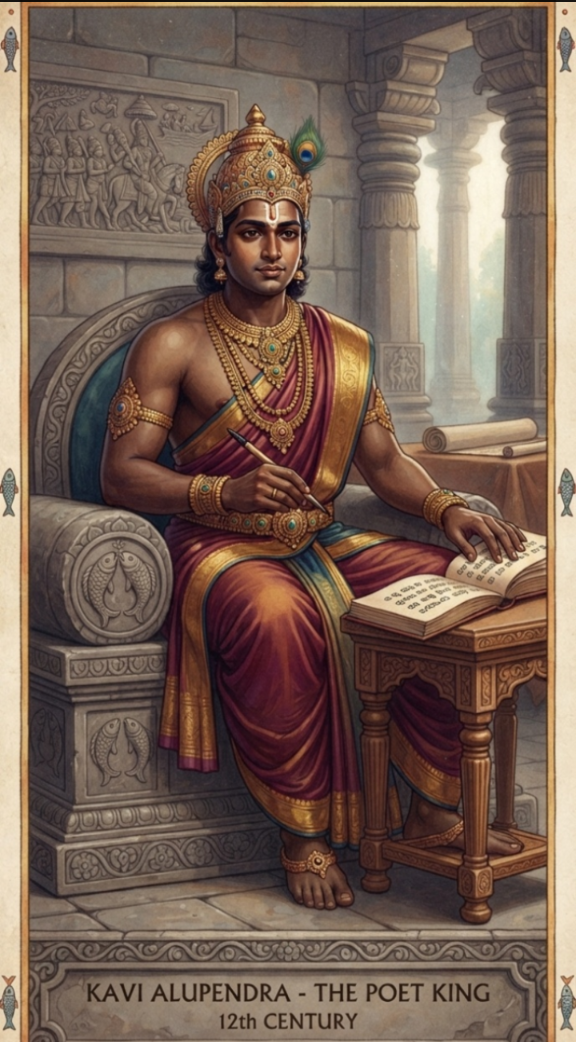
The Aadhi Kavi: The First Poet King of the West Coast
Kavi Alupendra is historically recognized as the Aadhi Kavi—the First Poet—and the inaugural Poet King of the entire West Coast. His reign marked a definitive turning point, shifting the region from a collection of maritime trade outposts to a center of intellectual and literary power. By championing Tulu as a primary language of courtly and religious discourse, he secured its position as the foundational literary language of the entire region.
Devi Mahatme: The Dawn of Tulu Literature and Shaktism
The formal recording of the Devi Mahatme stands as one of the most significant cultural milestones in South Indian history. Tulu holds the distinct honor of being the first Dravidian language to formally record this foundational epic, a testament to the sophistication and reach of the Alupa dynasty. This accomplishment is irrefutable evidence of the deep-rooted influence of Shaktism in Tulu Nadu, reflecting a society where the divine feminine was central to both royal patronage and spiritual life. By elevating the Devi Mahatme into the regional script, King Kavi Alupendra institutionalized the worship of the Goddess as the heart of our civilization.
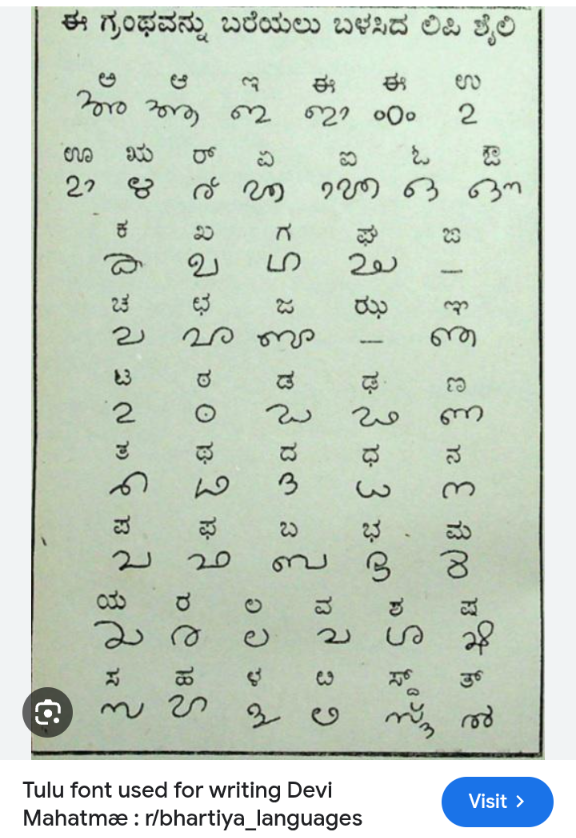
The script used to formalize the Devi Mahatme.
Tulu’s Position in the Dravidian Literary Landscape
| Language | Literary Status | Role of Early Scripture |
|---|---|---|
| Tulu | Aadhi Kavi Era Literary Tongue | First Dravidian language to formally record Devi Mahatme |
| Tamil | Classical Sangam Tradition | Early poetic anthologies |
| Kannada | Kavirajamarga Era | Codification of poetic standards |
Critical Attribution: Why Kavi Alupendra?
The attribution of the Devi Mahatme to Kavi Alupendra is not merely honorary; it is a critical necessity of 12th-century literary patronage. Alupendra’s court strictly adhered to the rigorous poetic and linguistic standards codified in Kavirajamarga. The structural integrity of the Tulu verses, their rhythmic adherence to the Sutra-like precision demanded by classic treatises, and the deliberate synthesis of regional phonetics with pan-Indian metaphysical themes, all point to a singular, authoritative royal hand. He did not merely commission the work; he codified the language to meet the highest standards of the age.
Historical Evidence
The historical record for King Kavi Alupendra is supported by a multi-dimensional framework of cartographic, epigraphic, and architectural assets.
The Sovereign Domain
The geopolitical reality of Alupendra’s reign is defined by the Alupa Territory map, which illustrates the strategic boundaries his forces defended during the turbulent era of Hoysala and Chola conflicts. By successfully restricting Chola incursions, he ensured the regional stability required for intellectual and artistic expansion.
The Epigraphic Record
The foundational proof of Tulu’s literary antiquity lies in the primary source inscriptions. These records, transcribed in the native script, document the institutionalization of Tulu under his patronage, specifically linking his sovereign authority to the formalization of the Devi Mahatme.
Architectural Legacy
Physical evidence of this era persists in the enduring structural heritage of the region, such as the Barkur stone temple. Together with his title of Kavi (or Kabi), these artifacts substantiate the existence of a high-culture society that successfully balanced iron-clad military defense with the profound cultivation of Tulu literature.
.png)

The Digital Reconstruction: Recovering the Script
The Tuluva Guardian is spearheading the development of an independent Android keyboard for the Tulu-Tigalari script. By integrating native font support, we are breaking the digital barriers that have kept our literature inaccessible, ensuring the script remains a functional part of our identity.
Tracing the Source: Our Legal Quest for the Original Writings
Despite the historical weight of this legacy, the original manuscripts remain shrouded in institutional opacity. We at the Tuluva Guardian have initiated formal legal proceedings and utilized Right to Information (RTI) channels to trace the locations of these foundational writings. Our ongoing investigations are designed to break through the bureaucratic silence of the Department of Kannada and Culture. We are dedicated to the legal recovery and forensic revelation of these documents, ensuring that the true content—the very ink and iron of our ancestors—is brought back into the light of public scrutiny.
The Title of Kavi Simha: A Royal Synthesis
The historical record is further solidified by the sovereign title Kavi Simha (Poet Lion), documented in the Gosada inscription. This title serves as an epigraphic bridge, elevating Alupendra beyond a regional ruler to a monarch of classical stature. Much like the imperial titles adopted by Samudragupta to signal a synthesis of martial dominance and intellectual patronage, the Kavi Simha designation confirms that the Alupa court functioned as a center of high culture, where the strength of the "iron" was matched by the refinement of the "ink."
Fulfilling the Criteria for Classical Language Status
Tulu’s claim to classical status is structural. By providing evidence of high antiquity, a recorded literary tradition independent of modern influence, and the authorship of the Devi Mahatme as the first Dravidian epic of its kind, Tulu satisfies the essential criteria for classical recognition. This historical reality demands that Tulu be formally classified as a classical language, preserving its rightful place in India's intellectual heritage.
Through the Tuluva Guardian, we continue the sacred path of our ancestors, reclaiming the dignity of the language that first sang the praises of our coast.