
A striking visual window into our region’s war-torn past has resurfaced on social media, sparking intense interest among local historians, cultural enthusiasts, and the Tuluva community. An image of a beautifully preserved Hero Stone—referred to locally in archival circles as a Bantagall or Veeragallu—has emerged as a definitive testament to what a frontline Tuluva warrior actually looked like during the tumultuous 17th century.
Beyond its remarkable artistic preservation, the monument points directly to one of the most volatile and legendary military eras in the history of the Tulu country: the historic border wars between the Savantas of Mulki Seeme and the Choutas of Puttige Seeme.
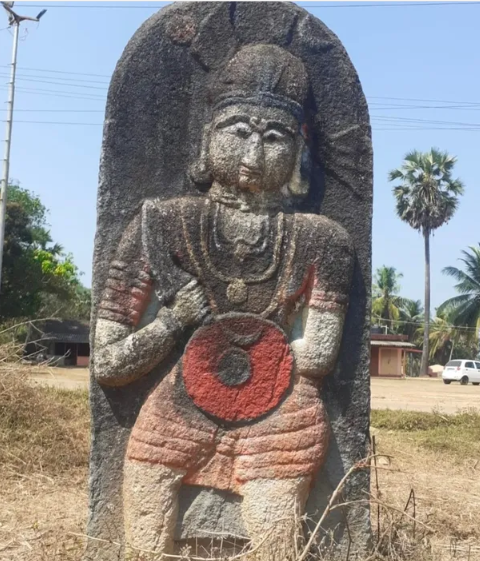
Figure 1: The documented Bantagall (Hero Stone) showing the authentic 17th-century combat gear, the distinctive Patti headpiece, and the central Paricha shield currently revered by local communities.
The Anatomy of a Tuluva Hero
The stone portrait breaks away from stylized mythology to show real, operational military equipment engineered for the humid, rugged coastal plain. The sculpture provides precise details regarding the combat loadout of our historical infantry:
A Window to the 1600s: The Cradle of Coastal Wars
By the dawn of the 17th century, the overarching protective canopy of the Vijayanagara Empire had collapsed, leaving a massive power vacuum across the coastal belt. As regional powers like the Keladi Nayakas attempted to enforce aggressive tax collections and territorial dominance, local principalities fiercely resisted. It was during this exact era that the Choutas of Puttige Seeme (centered around Moodbidri) launched aggressive military expansions against the neighboring Savantas of Mulki Seeme.
According to regional folklore and historical reconstructions, this was the environment that produced the legendary twin folk heroes, **Kanta Bare and Booda Bare**. Serving as the supreme military anchors for Mulki Seeme, they organized rapid-response village militias trained in local Garadis (martial arts academies) to defend the kingdom's borders.
"This stone portrait breaks away from stylized mythology to show real, operational military equipment engineered for the humid, rugged coastal plain."
Bunt or Billawa? A Shared Bloodline of Defiance
While early archival captions of the artifact label it a *Pattida Bontakalla*—implying an elite warrior from the Bunt chieftain community—modern epigraphists urge a more inclusive, nuanced interpretation. Without a legible written inscription surviving on the rock face, the warrior carved into the stone could just as easily represent an elite Billawa commander fighting shoulder-to-shoulder under the command structure of Kanta Bare and Booda Bare.
During these intense 17th-century border skirmishes, defenders from both communities underwent identical physical conditioning inside the Garadis. They went to war wearing the exact same tactical gear: the **Patti** (a structural, crown-like protective helmet), the **Paricha** (a sturdy, circular combat shield held firmly at the waist), and lightweight specialized waist garments designed for high agility in close hand-to-hand combat and dense jungle skirmishes.
The prominent red circular motif freshly painted onto the stone's abdomen area highlights a beautiful cultural reality: centuries after the warrior's specific name has been lost to time, local villagers still worship the stone as a Daiva or Karana (ancestral guardian spirit), completely transcending rigid modern caste boundaries.
Preserving the True Face of Tulunadu
This Veeragallu stands as a direct reminder that Tulunadu's history was built on the backs of everyday village protectors, not just distant emperors. He was an unnamed defender who stood his ground, looked an invading army in the eye, and sacrificed everything to keep the borders of his homeland safe.
As this image continues to gain traction online, it serves as a powerful call to action for local youth and administrative bodies to document, protect, and honor the thousands of neglected hero stones weathering away in our village fields. They are not just rocks; they are the literal mirrors of our ancestors.